
Curation
Learn how JFrog Curation enforces security and license policies before download.
In today's software development landscape, organizations rely heavily on open-source and third-party packages to accelerate development. However, this introduces risks such as security vulnerabilities, license compliance issues, and supply chain attacks. JFrog Curation addresses these concerns by providing an automated, policy-driven approach to controlling software package usage.
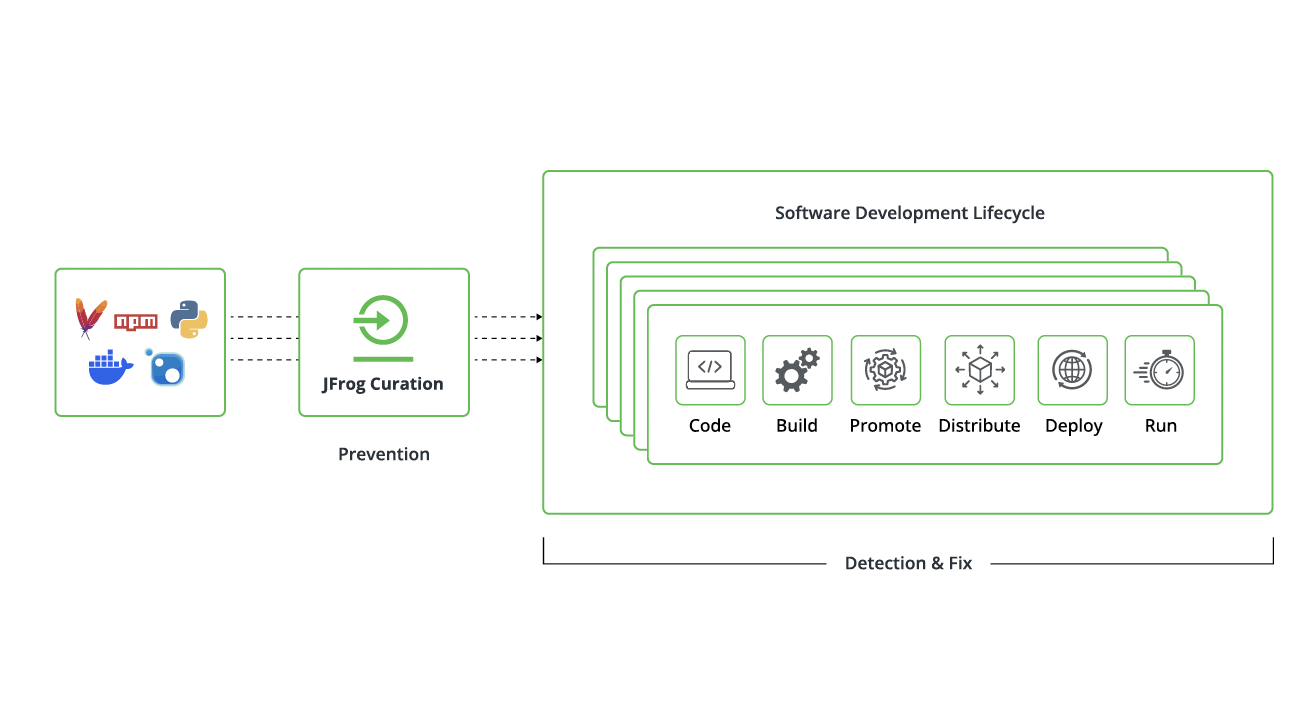
Where JFrog Curation Sits in the Security Timeline
JFrog Curation is the first line of defense in securing an organization’s software supply chain. It operates at the package acquisition stage, preventing risky dependencies from entering remote repositories before they're even used in development, testing, or production. For local repository protection, JFrog Xray provides security gating.
JFrog Curation applies pre-download open-source software (OSS) governance.
- When: As OSS packages are fetched for use.
- Purpose: Curation enforces security and compliance policies automatically.
Note
For more information, see Getting Started with Curation.
Business Needs for JFrog Curation
Organizations face increasing challenges in managing the security and compliance of their software supply chain. These include:
- Preventing Supply Chain Attacks: Attackers increasingly target public package repositories to inject malicious software. JFrog Curation prevents the download of risky or compromised packages before they enter the development environment.
- Managing Open-Source Risks: OSS dependencies come with security vulnerabilities, license restrictions, and potential legal risks. Organizations need a systematic way to control which packages can be used.
- Regulatory Compliance and Governance: Compliance frameworks, for example GDPR, HIPAA, and SOC 2, require organizations to ensure that external dependencies meet security and licensing standards.
- Reducing Security Overhead: Security teams often struggle with manual reviews of dependencies. Automated package curation reduces this burden and ensures continuous compliance.
- Enhancing Development Efficiency: Developers lose productivity when they unknowingly introduce non-compliant or vulnerable packages and must later rework their code. Curation proactively prevents these issues.
- Minimizing Development Disruptions: When a requested package version is blocked, Compliant Version Selection automatically returns the highest version that passes all policies. Developers can keep working without failed builds or manual intervention.
- Consistent Governance Across All Sites: Organizations operating multiple JFrog Platform Deployments need a way to enforce the same curation rules everywhere. Curation Federation synchronizes policies, conditions, and JFrog Catalog labels from a central controller site to all connected sites, eliminating manual replication and ensuring uniform compliance.
- Securing Uncataloged Packages: Not all remote repositories are covered by the JFrog Public Catalog. On-Demand Curation extends policy enforcement to packages from internal, private, or ecosystem-specific repositories, applying real-time vulnerability, license, immaturity, and malicious code evaluation before the package reaches the developer.
Key Issues JFrog Curation Resolves
JFrog Curation resolves the following issues.
| Issue | How JFrog Curation Solves It |
|---|---|
| Malicious Package Downloads | Blocks known malicious or compromised packages before they reach developers. |
| Security Vulnerabilities | Uses real-time metadata from the JFrog Catalog to prevent the use of packages with critical CVEs. |
| License Compliance Risks | Automatically blocks packages that violate corporate legal policies. |
| Unapproved Open-Source Usage | Allows only pre-approved or vendor-certified packages using allowlist policies. |
| Aging and Abandoned Packages | Prevents outdated, unmaintained, or deprecated dependencies. |
| Operational Instability | Ensures that only stable and secure package versions are used in production. |
| Blocked Versions Breaking Builds | Compliant Version Selection automatically returns the highest policy-compliant version instead of blocking the request, keeping development flowing. |
| Inconsistent Multi-Site Rules | Curation Federation propagates policies and conditions from a central controller site to all follower sites, keeping all sites in sync. |
| Uncataloged Repository Packages | On-Demand Curation extends policy enforcement to packages from repositories not in the Public Catalog, applying real-time security evaluation. |
Related Topics
Updated 13 days ago