

Federation Members and Topology
Learn how Federation members form a mesh topology with independent metadata and binary sync.
A Federation is a collection of Federated repositories in up to 10 JFrog Platform Deployments (JPDs) at different sites. Each Federated repository in the group is referred to as a Federation member. Members are automatically configured for full bi-directional replication.
Federated Topology
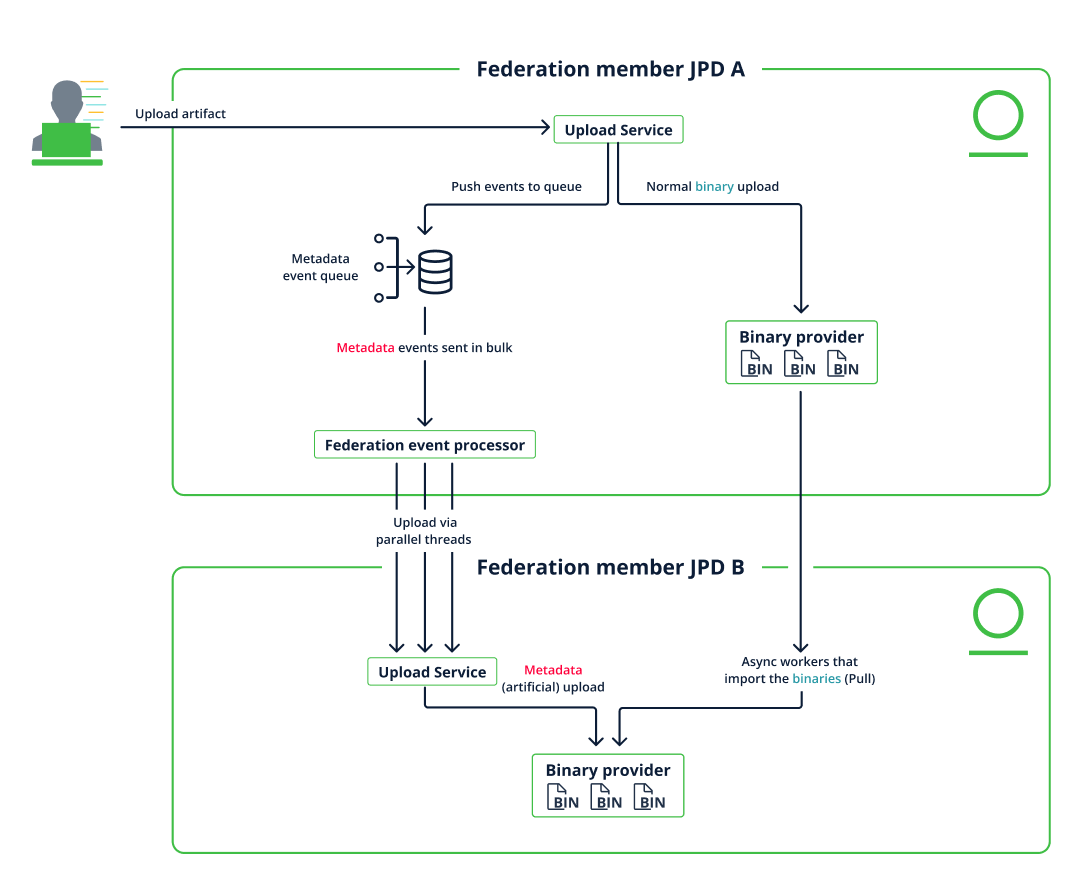
Federated repositories employ a topology with two separate but integrated mechanisms, whereby artifact metadata is replicated continuously but separately from the binary content.
- Metadata replication: Metadata is replicated rapidly in bulk to enable fast synchronization. This is critical because file properties cannot be uploaded before the file itself is uploaded. This is especially true when working with Docker manifests, which cannot be uploaded before the layers listed in the manifest are uploaded.
- Binary replication: Binary content is brought asynchronously using a separate mechanism based on workers. Priority can always be given to specific binaries on user demand as required.
Dividing the federation of the metadata and the binaries into two separate mechanisms provides a solution with excellent scalability.
Member Independence
There is no dependency among Federation members, nor is there member priority when synchronizing the metadata. This means that a member which is slow to respond or experiencing heavy traffic doesn't impact the other members.
Member Limitations
- Only Platform Administrators can set up a Federated repository and add members to the Federation.
- You can't connect a Terraform Backend repository to a Federated repository. This limitation prevents inconsistencies in the system state, which could lead to unexpected behavior or errors.
Related Topics
Updated 3 months ago