

Repository Management
Learn how JFrog Artifactory uses local, remote, virtual, and Federated repositories.
In JFrog Artifactory, a repository is a place to organize your artifacts into a cohesive, organized group by application and project. Artifactory hosts the following repository types:
- Local repositories store and manage the artifacts that your organization uploads or creates internally, sometimes referred to as first-party and second-party artifacts. They are ideal for storing the build artifacts, binaries, and other packages that you generate.
- Remote repositories serve as a caching proxy for repositories managed at a remote URL, such as a public registry. These repositories contain artifacts that originate outside your local machine, for example, your project's dependencies.
- Virtual repositories aggregate an unlimited number of local and remote repositories to create controlled domains for the search and resolution of artifacts.
- Federated repositories synchronize their contents with other Federated repositories located at remote sites that are part of the same Federation.
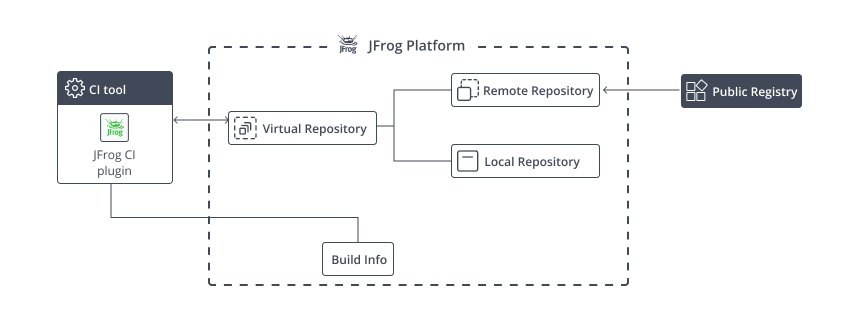
Build Info is all the information collected by the build agent, which includes details about the build. For more information, see About Build Info.
Note
If you have an Enterprise+ subscription with JFrog Distribution, you can also create and manage Release Bundle repositories, which collect a signed group of artifacts and protect them from changes to ensure consistent distribution to targets, such as JFrog Artifactory Edge services.
Learn more about Repository Management at JFrog Academy!
Related Topics
Updated 28 days ago